Insights
When stablecoins improve cross-border settlement – and when they don’t
Assess the operating benefit, funding requirements and cost of changing a specific flow.
Definition
Whether a stablecoin improves institutional cross-border settlement depends on the corridor, not the asset class. A regulated digital currency can relieve a specific middle-mile friction – operating windows, trapped prefunding, unclear state – while customers, licensing, FX and domestic payout remain in existing systems. It does not help when the incumbent rail already meets the requirement, or when issuer, ramp or last mile is the constraint.
Whether a stablecoin improves a cross-border flow is a property of the corridor, not of the technology. The same settlement asset that removes a real constraint in one corridor adds cost and moving parts in the next. So the useful question is never “are stablecoins better than correspondent banking” – it is “what does this corridor’s incumbent rail actually cost, in capital, hours and ambiguity, and does a different settlement asset relieve any of it.”
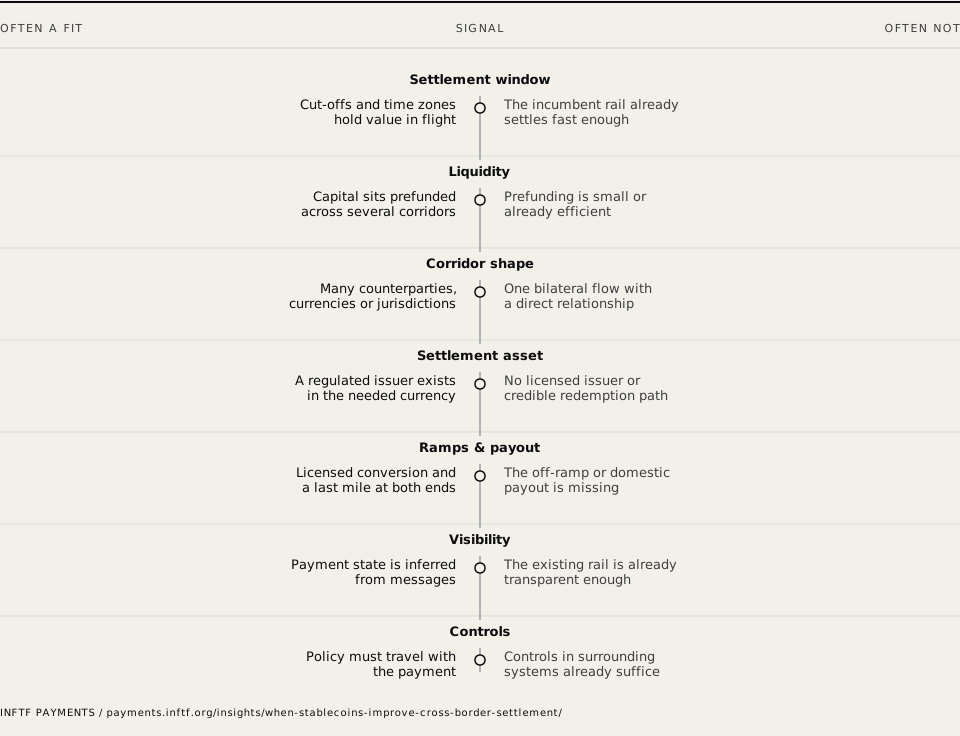
Assess both the potential improvement and the cost of achieving it. Integration, custody, asset acquisition and redemption, FX, ongoing operations and fallback arrangements all belong in the comparison. The decision matrix below helps identify where further work is justified.
When they tend to help
- Costly or slow settlement windows
When value waits on cut-offs, banking days and time zones, a ledger that settles outside conventional banking hours removes a real constraint – provided the ramps and payout can keep up with it.
- Trapped liquidity
When prepaid nostro positions sit across several corridors, a common settlement asset and faster settlement can shrink or consolidate them in suitable models. Prefunding often moves rather than disappears; the gain has to be shown in the corridor’s own funding model.
- Multi-country flow
A common settlement asset may simplify funding and reconciliation across several counterparties. The benefit depends on their ability to accept, hold and redeem the asset and on the conversion and payout arrangements at each endpoint.
- A stable, regulated settlement asset
The fit exists only if a regulated issuer offers the needed currency with credible redemption. Where such an asset exists, the legal perimeter can close; where it does not, no ledger property compensates.
- Strong on-ramps and off-ramps
Licensed conversion at both ends, with real capacity, is what makes ledger settlement usable. A corridor with strong ramps converts a technical gain into an operational one.
- Need for ledger visibility
When payment state is currently inferred from messages and statements, a deterministic shared record of the settlement leg reduces ambiguity, reconciliation breaks and investigation time.
- Need for programmable controls
When policy must travel with the payment – authorisation rules, limits, allow-lists – enforcing it at the settlement account can be simpler and more auditable than reconstructing it in surrounding systems.
When they tend not to
- An efficient existing rail already solves the problem
If the incumbent rail already delivers the speed and economics the flow needs, the total cost of change exceeds the benefit. The incumbent often wins, and that is a legitimate outcome of the assessment.
- Weak liquidity
If the model depends on selling the settlement asset in a thin market, every payment pays the spread. An institutional model can avoid that by acquiring and redeeming the asset directly with a regulated issuer, so the asset itself is not traded. The liquidity question then moves to redemption capacity and the local currency: in a managed or thin FX market, conversion – not settlement – sets the price.
- No regulated asset
For a model requiring a regulated settlement asset, the absence of a suitable issuer or credible redemption path is a reason to reconsider the proposed instrument or rail.
- No domestic payout
A settlement asset with no licensed payout partner reaches an account balance, not a recipient. Without a last mile, the corridor does not exist.
- Custody burden too high
Key management, signing governance and recovery procedures are a permanent operational cost. If that cost exceeds the corridor’s measurable gain, the design is net negative.
- Legal uncertainty
If the asset’s classification, the finality of settlement or the permissibility of the flow is unclear in any jurisdiction it touches, the corridor is not ready – whatever the technology.
- A counterparty mandate
If the institutions on the other side of the flow require a different rail, interoperability beats preference. A settlement asset only works when both sides will hold it.
- Added complexity without measurable benefit
A new asset, ledger and custody model are new moving parts. If no metric – capital, hours, breaks, cost – improves measurably, the complexity is the whole outcome.
Use-case decision matrix
What the live corridor shows – and what it does not
On 6 May 2026, TerraPay, Cooperative Bank of Oromia and Quantoz Payments launched blockchain-based settlement for euro-denominated inward remittances from Europe to Ethiopia, developed in collaboration with INFTF. Regulated euro e-money settles between institutions on Xahau. Recipients are paid in local currency by their domestic bank – no one in Ethiopia is asked to hold a foreign digital currency.
Run the corridor through the matrix above and the fit is legible: a multi-party flow, a regulated euro-denominated settlement asset, an established cross-border network on the sending side, a licensed domestic bank on the receiving side and – according to TerraPay’s announcement – approval from Ethiopia’s central bank for inward remittance flows. On liquidity, Quantoz’s CEO said in the Cooperative Bank of Oromia announcement that a regulated digital euro can reduce the need for costly pre-funding; the funding model remains central to assessing the benefit for any further corridor.
The transferable lesson is the alignment of regulated money, an established sending network and a domestic bank. Another corridor still needs its own comparison of settlement windows, funding positions, conversion costs and operating responsibilities. The benefit depends on whether those arrangements resolve the constraint in that flow.
Assess a flow
You do not need a finished architecture. A short description of the payment problem is enough.
Stablecoin cross-border settlement · Stablecoin remittance infrastructure · Stablecoin payment infrastructure · Europe → Ethiopia remittance settlement · Owning your payment architecture